
10 Best Vinyl Tile Plank Flooring Options to Buy?

Time:2026-11-09 Author:Madeline
0%

Vinyl Tile Plank Flooring is popular for rooms that need practical, easy-to-clean surfaces, but products can differ sharply in construction, comfort, and cost. Grand View Research estimated the global vinyl flooring market at about $25.6 billion in 2023, reflecting strong demand for the category. Market growth, however, does not make every plank a good fit for every home.

This guide compares ten options by factors buyers can check: wear-layer thickness, installation method, water-resistance claims, warranty terms, and published emissions information. FloorScore, administered by SCS Global Services with the Resilient Floor Covering Institute, evaluates indoor-air emissions from flooring products. It is useful evidence, but it does not measure durability or prove that one floor suits every room. Read the product’s full specifications.

Look closely at the sample. A printed oak grain may appear convincing online, then look repetitive under bright kitchen lights. Subfloor preparation matters, too; even premium flooring can feel uneven over dips or debris. Small details count. We’ll note where a product’s strengths come with trade-offs, because “waterproof” does not mean damage-proof under every installation or condition. Use this shortlist as a starting point, then confirm current pricing, availability, and manufacturer instructions before buying.
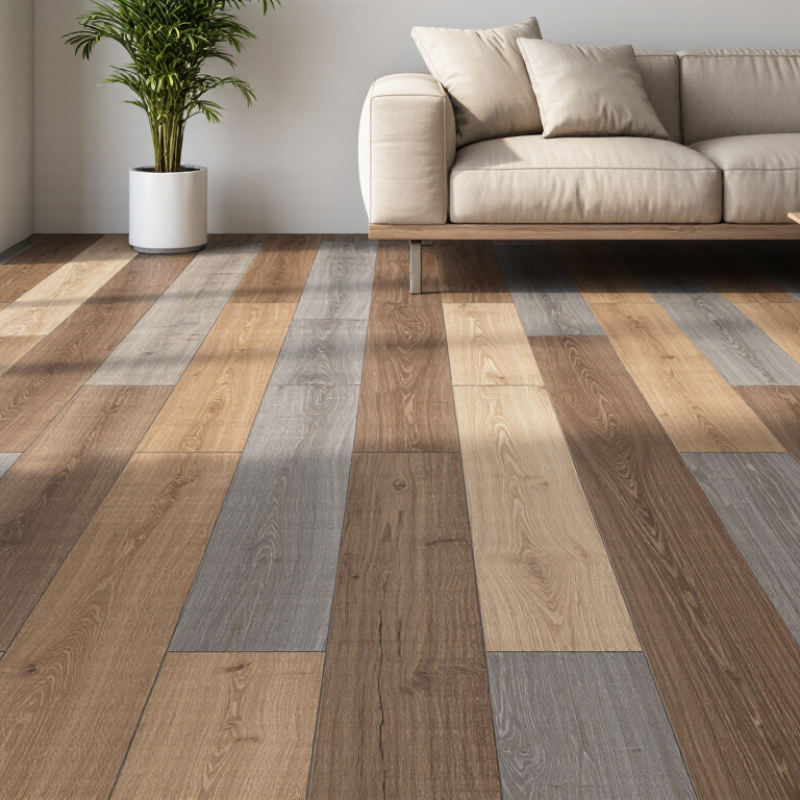
10 Best Vinyl Tile Plank Flooring Options to Buy?

Define LVT and LVP Types Using ASTM F1700 Classification

LVT means luxury vinyl tile; LVP is the plank-shaped version. The names describe format, not necessarily construction. ASTM F1700, the industry specification for solid vinyl floor tile, classifies products by how their patterns are made: Class I is solid vinyl, Class II uses a printed film, and Class III has an inlaid pattern. Surface types include smooth and embossed. Check the product’s technical sheet; “LVP” alone does not tell you its ASTM class.

ASTM F1700 assesses properties including thickness, dimensional stability, residual indentation, and chemical resistance. These measurements matter in a real room: a dining chair can leave a dent, while sunlight beside a glass door may challenge dimensional stability. Look for test results tied to the exact product, not broad claims about vinyl flooring.

A printed-film design can show convincing wood grain, but its appearance does not make it an inlaid pattern. Small distinction.

The standard helps compare construction and performance, yet it does not rank planks from best to worst. Installation conditions still matter, and an uneven subfloor can undermine an otherwise suitable choice.

Compare 10 Flooring Options by Wear Layer, Core, and Warranty

When comparing ten vinyl plank options, start with the wear layer: it helps resist scuffs, but thickness alone does not guarantee quality. A 6-mil flexible-core plank suits a quiet spare room; its shorter wear warranty may be limiting.

An 8-mil version offers a modest step up. A 12-mil flexible plank is a practical middle ground for light household traffic. A 12-mil SPC plank adds a rigid stone-plastic core, which can feel firm underfoot. Check the fine print.

For busier rooms, a 20-mil SPC option usually offers more surface protection than thinner choices. A 20-mil WPC plank has a wood-plastic core and may feel softer, though it can be thicker.

A 22-mil SPC option is another candidate for kitchens or hallways. A 28-mil SPC plank targets heavy use, but its price and warranty exclusions deserve a close look. Wear layers are often listed in mils, not millimeters.

A 20-mil loose-lay plank can simplify replacement, but the floor beneath it must be smooth and clean. A 30-mil commercial-grade SPC option may suit entryways, yet a commercial rating does not automatically mean a longer residential warranty.

Compare coverage length, installation requirements, water-related exclusions, and whether the warranty is prorated. A sample can reveal texture and stiffness. It cannot show how every joint will hold up over years of cleaning and foot traffic.

Check VOC Emissions Against FloorScore and CDPH Standard Method

When comparing vinyl tile plank flooring, don’t treat “low-VOC” as a complete answer. Emissions vary by product, and a strong smell cannot reliably measure them. Check documentation for the exact flooring line and model, not just a general claim about a product range. FloorScore certification is based on testing under the CDPH Standard Method, so these references are related rather than separate guarantees. Labels matter.

Tips: Ask for a current certificate or test report, and confirm that it names the product you plan to buy. Check whether the tested configuration matches your flooring, including any underlayment. Keep the paperwork; details are easy to forget.

Installation materials can affect indoor emissions, too. Review guidance for adhesives and underlayments, and ventilate the room during and after installation as directed. A certificate is useful evidence, but it cannot predict every home’s air quality or replace careful product selection. I would also compare warranty and maintenance details; emissions get attention, while those everyday considerations are sometimes overlooked. A little uncertainty remains, especially when reports are hard to interpret, so ask the seller to clarify test dates and product coverage before purchasing.

Match Plank Format and Click-Lock or Glue-Down Installation to Room Use

10 Best Vinyl Tile Plank Flooring Options to Buy?

Plank format affects how a room feels and how the floor performs. Long, wide planks can make a small room appear calmer, but they may highlight uneven walls or a crooked installation line. Shorter or narrower planks offer more layout flexibility around doorways and alcoves. Measure the room, then sketch the plank direction before choosing. A popular look is not always the easiest fit.

Click-lock planks usually float above the subfloor, so installation can be quicker and individual boards may be easier to replace. The surface beneath them still needs to be clean, dry, and level; small bumps can cause clicking or separation. Glue-down flooring can feel more stable in busy areas or beneath rolling chairs, but it demands careful surface preparation and adhesive application. It is less forgiving. I would not choose an installation method by speed alone; room traffic and subfloor condition matter more.

Tips: Check the flooring instructions for expansion gaps, moisture limits, and approved underlayment. In kitchens or entryways, consider how spills, grit, and frequent cleaning affect the floor. For glue-down planks, confirm the subfloor is compatible and allow the adhesive to cure fully. It is easy to overlook thresholds, until a door catches.

Typical Vinyl Plank Widths

Representative dimensions for comparing narrow, standard, and wide plank formats.

Vinyl plank widths commonly range from about 4–6 inches for narrow formats to 8–9 inches or more for wide formats; exact sizes vary by product. Choose click-lock or glue-down installation according to room conditions and the flooring manufacturer’s instructions.

Assess Static-Load Performance Under ASTM F970 and Review Care Needs

A vinyl plank’s static-load result can help predict how it responds to heavy, stationary furniture. ASTM F970 measures residual indentation after flooring is exposed to a specified load and test period. Check the product’s technical sheet for both the reported result and the conditions used. Small marks matter. A number without its test conditions is hard to compare fairly across options.

A test result is not a promise that a floor will resist every dent. A loaded bookcase, a narrow table leg, and a rolling office chair apply pressure differently. I would not treat one rating as a guarantee; the test setup can feel far removed from a busy room. Use broad furniture glides or felt pads, and lift items instead of dragging them. Replace worn pads when grit collects beneath them.

Care needs are practical, but details vary by flooring construction and finish. Sweep or vacuum loose grit before damp mopping; fine sand can scratch the surface like tiny grains of glass. Use a cleaner approved for the flooring, and avoid abrasive pads or excess water. Check the care instructions before using steam or strong cleaners. Spills are usually simple to manage, yet seams still deserve prompt attention. Keep a small cloth nearby, especially near sinks and entryways.

10 Best Vinyl Tile Plank Flooring Options to Buy? - Assess Static-Load Performance Under ASTM F970 and Review Care Needs

Compare these common, unbranded flooring constructions as starting points. Thickness and wear-layer figures are indicative ranges found across product categories, not specifications for every product. Static-load performance is product-specific and cannot be reliably ranked by construction type alone.

Option Construction Common format and indicative thickness Typical wear-layer range ASTM F970 static-load check Care needs
1. Glue-down LVT plank Flexible solid-vinyl plank adhered to the subfloor Plank; often about 2–3 mm overall Commonly 6–30 mil (about 0.15–0.76 mm) Request the exact product’s report, including load, dwell time, and residual indentation. Adhesion and subfloor preparation affect results. Sweep or vacuum; damp-mop with a pH-neutral cleaner. Avoid abrasive pads and excess water.
2. Glue-down LVT tile Flexible solid-vinyl tile adhered to the subfloor Square or rectangular tile; often about 2–3 mm overall Commonly 6–30 mil (about 0.15–0.76 mm) Check the product-specific ASTM F970 result; do not treat tile format as a performance rating. Use a soft broom or vacuum and a damp mop. Clean spills promptly and follow the care instructions for the finish.
3. Standard SPC click plank Rigid stone-polymer composite core with a vinyl wear surface and click joints Plank; commonly about 4–7 mm overall, sometimes with attached backing Commonly 6–22 mil (about 0.15–0.56 mm) Obtain a report for the complete flooring construction. A rigid core alone does not establish the ASTM F970 result. Sweep or vacuum and damp-mop. Avoid steam cleaning unless the product instructions explicitly permit it.
4. SPC tile Rigid stone-polymer composite core in a tile format Square or rectangular tile; commonly about 4–7 mm overall Commonly 6–22 mil (about 0.15–0.56 mm) Ask for the tested product’s residual indentation and test conditions; verify suitability for concentrated furniture loads. Remove grit regularly; damp-mop with a cleaner approved for resilient flooring. Use non-staining furniture protectors.
5. WPC click plank Wood-polymer composite core with a vinyl wear surface and click joints Plank; commonly about 5–10 mm overall, depending on backing Commonly 6–22 mil (about 0.15–0.56 mm) Use the exact product’s ASTM F970 report. Do not assume a thicker plank will have lower indentation. Sweep or vacuum and damp-mop; wipe spills promptly. Follow limits on standing water and cleaning products.
6. WPC click tile Wood-polymer composite core in a tile format Square or rectangular tile; commonly about 5–10 mm overall Commonly 6–22 mil (about 0.15–0.56 mm) Check the product-specific test result and installation requirements, especially for heavy fixed equipment. Use a soft broom or vacuum and a damp mop. Avoid abrasive tools and unapproved waxes or polishes.
7. Loose-lay vinyl plank Flexible plank designed to stay in place through its backing, weight, and specified installation method Plank; thickness varies by product, commonly a few millimetres Varies by product; check the published specification Request test data for the exact product and installation. Static loads may also challenge the floor’s ability to remain in place. Sweep or vacuum and damp-mop. Follow the manufacturer’s instructions for water, cleaning solutions, and replacement planks.
8. Dry-back commercial LVT plank Commercial-grade flexible LVT installed with adhesive Plank; often about 2–3 mm overall Often 20–30 mil (about 0.51–0.76 mm); verify the product specification Look for the product’s ASTM F970 report and confirm its test conditions match the intended application. Use walk-off mats, remove grit frequently, and clean with a neutral-pH product approved for the floor finish.
9. Enhanced-wear-layer LVT plank LVT plank with a thicker transparent wear layer; installation may be glue-down or click-lock Plank; overall thickness depends on the core and installation system Often 20–30 mil (about 0.51–0.76 mm); check the published figure A thicker wear layer concerns surface wear, not a guaranteed improvement in static-load indentation. Verify ASTM F970 data separately. Sweep or vacuum and damp-mop; use furniture pads to help prevent scratching and finish damage.
10. Textured or embossed LVT plank Vinyl plank with a textured surface; may be flexible glue-down or rigid-core click construction Plank; overall thickness varies with construction Varies by product; check the published specification Ask for ASTM F970 results for the exact construction; surface texture does not establish static-load performance. Use a soft brush or vacuum attachment to remove dirt from texture, then damp-mop with an approved cleaner.

Buying note: ASTM F970 evaluates indentation under a specified static load and reports the test result under stated conditions. Compare reports only when the load, dwell time, specimen preparation, and other test conditions are comparable. Ask for the current report for the exact flooring product; do not infer a pass or a numeric result from the product category alone.

FAQS

What does a vinyl plank’s wear layer do?

It helps resist scuffs and surface wear. Thickness alone does not guarantee quality.

Which wear-layer thickness may suit a quiet spare room?

A 6-mil flexible-core plank may work for light use. Its shorter wear warranty could be limiting.

How do SPC and WPC cores feel underfoot?

SPC has a rigid stone-plastic core and can feel firm. WPC has a wood-plastic core and may feel softer.

Is a thicker wear layer always the best choice?

Not necessarily. A 28-mil option targets heavy use, but price and warranty exclusions deserve a close look.

What should I check when comparing flooring warranties?

Compare coverage length, installation requirements, water-related exclusions, and prorated terms. Read the fine print.

What does an ASTM F970 result tell me?

It reports residual indentation after a specified load and test period. Check the test conditions, too.

Can an ASTM F970 rating prevent furniture dents?

No rating guarantees that. A bookcase and a narrow table leg apply pressure differently.

How can I reduce dents and scratches from furniture?

Use broad glides or felt pads, and lift furniture instead of dragging it. Replace pads when grit collects underneath.

How should I clean vinyl plank flooring?

Sweep or vacuum loose grit before damp mopping. Fine sand can scratch like tiny grains of glass.

What should I know about samples and loose-lay planks?

Samples reveal texture and stiffness, but not years of joint wear. Loose-lay planks need a smooth, clean floor beneath them.

Conclusion

This guide explains how to distinguish luxury vinyl tile (LVT) from luxury vinyl plank (LVP) using the ASTM F1700 classification, then compares ten flooring options based on wear-layer thickness, core construction, and warranty coverage. It also outlines how to check product emissions documentation against FloorScore and the CDPH Standard Method, helping readers consider indoor air quality alongside durability and design.

Choosing Vinyl Tile Plank Flooring also means matching plank size and installation method to the room. Click-lock systems may suit some floating-floor applications, while glue-down products can be appropriate where a firmly bonded surface is preferred. The guide reviews static-load performance under ASTM F970 and summarizes practical care needs, so readers can weigh appearance, installation, resilience, and maintenance before making a selection.

Madeline

Madeline

Madeline is a dedicated marketing professional with a wealth of expertise in our company's core offerings. With a keen understanding of the industry, she brings a unique perspective to her role, consistently delivering high-quality content that highlights the superior aspects of our products. As......