
Why Choose Vinyl Laminate for Global Projects? The answer begins with practical performance, not fashion alone. In airports, retail stores, hotels, and residential developments, surfaces face heavy traffic, rolling luggage, moisture, and frequent cleaning. Vinyl Laminate can respond to these demands with layered construction, realistic textures, and consistent visual quality. It also supports efficient installation when project schedules are tight.
Dean Thompson, a longtime resilient-flooring industry leader, captures this concern clearly: “Performance matters most when materials must travel farther and work harder.” His observation reflects a global reality. Materials may cross oceans before reaching a construction site. They must survive packaging, temperature changes, storage delays, and different installation conditions. Careful specification therefore matters as much as appearance. Wear-layer thickness, surface texture, dimensional stability, slip resistance, and maintenance requirements deserve close review. So does regional availability.
Small details matter.
A contractor in Singapore may prioritize humidity resistance. A hotel developer in Germany may focus on acoustic comfort and fire-performance documentation. A retail team in Canada may need rapid replacement for damaged planks. Vinyl Laminate can support these varied requirements, but it is not automatically the perfect choice. Subfloor moisture, adhesive compatibility, and installer training can still create problems. That limitation deserves honest attention.
Experience should guide the decision. Project teams should request technical data, sample panels, warranty terms, and installation guidance before approval. They should also test the product under realistic lighting and traffic conditions. Global projects need more than attractive specifications. They need dependable coordination, verified performance, and a material that remains practical after installation.
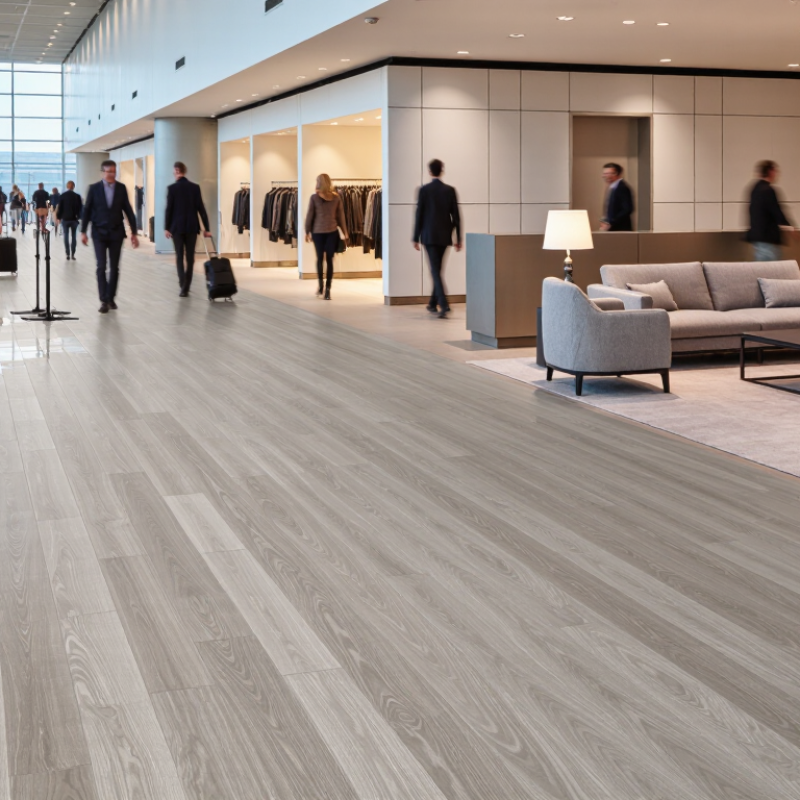
Vinyl laminate is a flexible surface material made from several bonded layers. A typical structure includes a wear layer, printed design film, vinyl core, and backing layer. The printed film creates the appearance of wood, stone, metal, or solid color. The wear layer protects it from daily friction, light spills, and moderate scratching.
How does it work? The material is cut into panels or sheets, then attached to a clean, stable surface with suitable adhesive. Pressure helps remove air pockets and improves contact. Experienced installers check wall dryness, surface flatness, and room temperature before installation. A dusty substrate can cause weak bonding. Small bubbles may appear later.
It suits global projects because it is lightweight, easy to transport, and visually consistent across different sites. However, climate changes matter. High humidity can affect adhesion, while extreme heat may encourage expansion. Project teams should test a sample under local conditions before ordering large quantities. They should also confirm cleaning methods, fire requirements, and installation guidance for each region. It is not flawless. A low-cost adhesive or rushed preparation can reduce service life, even when the laminate itself is well made. Regular inspection around edges and joints remains practical, especially in busy corridors, retail interiors, and temporary project spaces.
Vinyl laminate suits global projects because its practical features travel well across climates and construction teams. Grand View Research valued the global resilient flooring market at approximately USD 40.7 billion in 2023. That scale reflects continuing demand for durable, easy-care surfaces. Vinyl laminate resists everyday moisture, surface staining, and moderate impact. These qualities matter in hotels, offices, schools, and retail spaces.
Installation efficiency is another advantage. Many systems use click-lock or adhesive methods, reducing wet work and shortening site disruption. This helps projects with tight schedules or limited local labor. Product consistency also supports repeatable specifications across countries. Designers can coordinate wood, stone, or concrete visuals without shipping natural materials from one region. Still, subfloor preparation remains critical. Poor leveling can cause movement, open joints, or visible defects.
Maintenance is simple. Regular sweeping and damp cleaning usually protect the surface. That can reduce long-term labor in high-traffic facilities. The U.S. Environmental Protection Agency recommends evaluating flooring through emissions, durability, and life-cycle considerations, not appearance alone. This is where project teams should be more careful. Not every vinyl laminate product has the same wear layer, slip performance, or environmental documentation. The 2023 Global Status Report for Buildings and Construction also links the built environment to 37% of global energy-related emissions. Therefore, procurement should examine service life, replacement waste, indoor-air testing, and regional recycling options. A lower purchase price may not remain lower after installation errors and early replacement.
Vinyl laminate can perform well across global projects, but climate changes the installation plan. In humid coastal areas, moisture may collect beneath the flooring and weaken adhesives or subfloors. A dry, level surface is essential. Use moisture testing before installation, especially in ground-floor rooms.
In hot climates, direct sunlight can warm exposed flooring and cause expansion at seams. Window coverings and suitable expansion gaps can reduce movement.
In colder regions, materials should acclimate indoors before installation. Sudden temperature changes may create gaps or slight curling.
I have seen small preparation errors become visible after seasonal changes. Vinyl is resilient, but it is not immune to poor site conditions.
Tips:
Keep cartons flat in the installation room for at least 48 hours. Check temperature and humidity daily. Seal vulnerable edges near entrances. Use entrance mats where rain, sand, or snow is common. Clean standing water quickly. For large international projects, confirm local installation guidance and test a sample area first. A sample may reveal color shifts under strong daylight or movement over heated floors. These checks add time, yet they often prevent expensive repairs. Climate data can guide decisions, but each building still behaves differently.
Vinyl laminate can simplify flooring work across borders. Many systems use click-lock joints and floating installation. They need fewer wet trades, fewer specialized tools, and less curing time. That matters when labor skills differ between project locations.
The 2024 Global Vinyl Flooring Market report by Grand View Research estimated the sector at about US$39 billion in 2023. This scale supports wider sourcing and more familiar installation practices.
Installation still depends on a flat, dry subfloor. ISO 10582 and local building standards provide useful performance references.
A project team should verify moisture limits before delivery, not after failure. In practice, installers can replace damaged planks individually, reducing disruption in occupied offices or hotels. The benefit is practical. Not perfect. Poor leveling can cause joint movement and visible gaps.
Daily maintenance is usually straightforward.
Regular vacuuming removes grit, while damp cleaning limits residue and water use. Waxing is commonly unnecessary for factory-finished surfaces. This can reduce recurring labor costs and chemical purchases.
The National Floor Safety Institute links effective floor care with lower slip risk, although cleaning quality remains decisive. For budgeting, RSMeans Data 2024 shows why regional labor rates and preparation work must be priced separately. Material cost alone is misleading. Shipping, waste, transitions, and replacement stock can change the final figure. A careful global specification may save money, but only when local climate, installer training, and repair access are checked early.
Vinyl laminate can suit global projects because it combines visual consistency, water resistance, and relatively simple installation. Grand View Research estimates that the global resilient flooring market reached about USD 40.9 billion in 2023. Its forecast also indicates steady growth through 2030. Yet market growth does not make every supplier dependable. Product quality still varies between batches.
Global buyers should examine measurable evidence, not attractive photographs. Request technical data for wear-layer thickness, total thickness, dimensional stability, slip resistance, fire performance, and volatile organic compound emissions. Check whether testing follows recognized standards, such as ISO 10582 or ASTM flooring methods. A credible supplier should provide current reports from independent laboratories. Reports should identify the tested construction, not only the product name. Ask for production samples from different batches. Compare color, locking strength, edge accuracy, and surface texture under warehouse lighting. Small differences become visible across a large hotel corridor.
Tips: Confirm pallet dimensions, carton protection, moisture controls, and replacement procedures before ordering. A supplier’s logistics record matters as much as its factory equipment. The World Bank’s Logistics Performance Index shows major differences in customs efficiency and shipment reliability across markets. Build realistic buffer time. Cheap freight planning can damage an otherwise strong project. Also review installation guidance for local climate conditions. Humid coastal storage can change flooring performance. I would question any supplier promising zero claims. Problems happen. Reliable partners explain causes, document corrections, and accept independent inspection when needed.
| Evaluation Dimension | Why It Matters for Global Projects | Recommended Reference Data | How Buyers Should Verify It | Commercial or Technical Risk |
|---|---|---|---|---|
| Product Construction | Multi-layer construction affects appearance, dimensional stability, comfort, and service life. | Confirm the product structure, including wear layer, printed design layer, core layer, backing layer, and surface coating. | Request a technical datasheet, cross-section diagram, and production sample from the same product series. | A visually similar sample may have a different internal structure and performance level. |
| Wear Layer Thickness | The wear layer protects the decorative surface from abrasion and routine traffic. | Typical commercial options commonly range from approximately 0.30 mm to 0.70 mm; higher-traffic areas generally require a thicker layer. | Check the declared thickness and request abrasion-test results or an independent laboratory report. | The wear layer should not be evaluated without considering traffic intensity, cleaning methods, and expected service life. |
| Overall Product Thickness | Total thickness influences installation height, acoustic behavior, impact comfort, and compatibility with doors and transitions. | Common resilient flooring constructions are often approximately 2.0 mm to 5.5 mm thick, depending on product type and backing. | Compare declared thickness with measured samples and confirm manufacturing tolerances. | Thickness differences can create installation problems at doorways, stairs, and adjacent floor finishes. |
| Format and Dimensional Tolerance | Consistent dimensions reduce installation waste and visible alignment problems across large international projects. | Verify plank or tile length, width, squareness, straightness, and thickness tolerance according to the applicable product standard. | Ask for batch inspection records and measure samples from more than one production batch. | Tolerance control is especially important when products are installed with tight joints or repeated patterns. |
| Dimensional Stability | Temperature and humidity changes during shipping, storage, and installation can cause gaps, curling, or joint movement. | Require dimensional-stability results using a recognized method such as ISO 23999 or the relevant regional product standard. | Review test conditions, percentage change, sample size, and acceptance criteria rather than accepting a pass statement alone. | A product suitable for one climate may require different acclimatization and installation controls in another climate. |
| Surface Abrasion and Stain Resistance | Global projects may involve retail, hospitality, education, healthcare, and office traffic with different cleaning routines. | Confirm abrasion classification and resistance to common contaminants such as coffee, oil, disinfectant, and diluted cleaning chemicals. | Request test reports and a written maintenance guide specifying approved and prohibited chemicals. | Aggressive chemicals, abrasive pads, and excessive moisture can reduce surface performance even when the product is correctly specified. |
| Slip Resistance | Slip performance is a safety consideration in entrances, corridors, kitchens, washrooms, and other areas exposed to moisture. | Request results under the applicable method, such as EN 16165, DIN 51130, ASTM E303, or a local equivalent. Ratings are not directly interchangeable between methods. | Check the exact test method, wet or dry condition, footwear condition, and intended-use classification. | A slip rating without its test method and conditions is not sufficient for cross-border comparison. |
| Fire Performance | Building codes and project specifications may impose different reaction-to-fire requirements by country and occupancy type. | For European projects, verify the classification under EN 13501-1; common project requirements may include a declared class such as Bfl-s1 or Cfl-s1, subject to the building design. | Request a valid classification report covering the exact product, backing, adhesive, and installation configuration. | Fire classification can change with the substrate, underlay, adhesive, and installation system. |
| VOC and Indoor Air Quality | Low-emission materials support indoor-air-quality requirements in offices, schools, healthcare facilities, and residential projects. | Request emissions data tested under a recognized chamber method, such as ISO 16000 series methods, and compare with the project’s local limits. | Review the complete report, test duration, chamber conditions, tested product reference, and detected substances. | A general “low VOC” claim is not equivalent to a verified emissions classification or local compliance certificate. |
| Chemical and Regulatory Compliance | Import regulations, restricted-substance rules, and public-project requirements vary by destination market. | Check applicable requirements such as REACH restrictions, phthalate limits, heavy-metal restrictions, and local chemical regulations. | Request a current declaration of conformity, restricted-substance test report, safety documentation, and product composition statement where available. | Compliance documents should identify the exact product series and date; generic company declarations may not cover every item. |
| Slip, Impact, and Acoustic Performance | Acoustic comfort and impact behavior are important in multi-unit housing, hotels, offices, and education facilities. | Where required, verify impact-sound reduction, walking sound, indentation, and residual indentation using the applicable ISO, EN, ASTM, or local method. | Confirm whether the result applies to the floor covering alone or to the complete floor-ceiling assembly. | Assembly-level performance cannot be assumed from a product-only test result. |
| Installation System | Click, loose-lay, dry-back, and self-adhesive formats have different substrate, adhesive, and installation requirements. | Obtain requirements for subfloor moisture, flatness, temperature, acclimatization, adhesive type, expansion gaps, and seam treatment. | Review the official installation manual and conduct a site mock-up before full installation. | Installation failures are often caused by subfloor conditions or incorrect adhesive selection rather than the surface material alone. |
| Climate and Shipping Suitability | Long-distance ocean transport and regional climate differences can expose products to temperature and humidity changes. | Confirm storage temperature, installation temperature, humidity limits, pallet configuration, packaging protection, and acclimatization period. | Request packaging specifications and inspect cartons for moisture damage, compression, and batch identification upon arrival. | Products should be stored indoors, protected from weather, and kept flat unless the manufacturer specifies another method. |
| Color and Batch Consistency | Large projects installed over several months require stable color, embossing, gloss, and surface texture between deliveries. | Confirm shade references, acceptable batch variation, production coding, and the supplier’s sample approval procedure. | Approve a signed control sample and compare every shipment against the approved reference before installation. | Install material from the same batch in continuous areas where possible to reduce visible variation. |
| Quality-Control System | Repeatable production controls reduce defects and improve consistency for multi-country procurement. | Evaluate incoming-material inspection, in-process checks, final inspection, traceability, corrective-action procedures, and calibration controls. | Request quality certificates, inspection plans, nonconformity records, and evidence of lot-level traceability. | A management-system certificate alone does not prove that every product batch meets the project specification. |
| Sample Approval and Testing | Pre-production approval aligns the supplier, contractor, architect, and buyer before mass manufacturing. | Approve color, texture, gloss, dimensions, construction, packaging, and performance requirements using a controlled reference sample. | Use a signed sample approval sheet and require written notification before any material or construction change. | Unapproved changes to backing, coating, embossing, or packaging can affect both performance and appearance. |
| Supply Capacity and Lead Time | Project schedules depend on reliable production capacity, raw-material availability, and export documentation. | Compare stated production capacity, standard lead time, peak-season lead time, minimum order quantity, and reserved-capacity options. | Request a written production schedule, capacity confirmation, shipment plan, and escalation contact for delays. | Lead times are commercial commitments, not inherent product properties; they should be confirmed for each purchase order. |
| Packaging and Palletization | Appropriate packaging reduces edge damage, moisture exposure, and handling losses during international transport. | Check carton strength, pallet dimensions, gross weight, moisture protection, labeling, stacking limits, and container loading plan. | Review packaging drawings and conduct a shipment inspection with photographs before dispatch. | Packaging should support local unloading equipment and comply with destination-country import requirements. |
| Documentation and Traceability | Complete documentation supports customs clearance, installation, warranty assessment, and future replacement orders. | Required documents may include technical datasheet, installation guide, maintenance guide, packing list, commercial invoice, test reports, and certificate of origin. | Check that documents identify product code, batch, revision date, test method, and applicable market. | Missing or inconsistent product codes can make claims, replacement orders, and regulatory checks more difficult. |
| Warranty and After-Sales Support | Clear responsibility for defects, installation issues, and replacement material protects the project after handover. | Review warranty duration, exclusions, claim procedure, required evidence, remedy options, and replacement-stock policy. | Require warranty terms in the purchase contract and define inspection, notification, and response timelines. | Warranty coverage may exclude substrate defects, unsuitable maintenance products, incorrect installation, and abnormal traffic. |
| Total Cost of Ownership | Lowest purchase price does not necessarily produce the lowest installed or life-cycle cost. | Compare material price, accessories, adhesive, freight, duties, installation labor, wastage, maintenance, replacement risk, and expected service life. | Prepare a landed-cost model for each destination and include realistic installation and maintenance assumptions. | A higher-specification product may reduce replacement, downtime, and maintenance costs in demanding applications. |
| Sustainability Information | Public and commercial projects increasingly request transparent environmental data and responsible material management. | Evaluate recycled content, recyclability, packaging reduction, environmental product declarations, manufacturing energy data, and take-back options where applicable. | Prefer verified environmental data with defined scope, system boundaries, and validity period. | “Eco-friendly” or “green” marketing language should not replace independently verified environmental information. |
It usually contains a wear layer, printed design film, vinyl core, and backing layer. A wood, stone, metal, or plain-color image sits beneath the protective surface.
Installers cut sheets or panels and attach them to a clean, stable surface. Pressure helps remove trapped air. The surface must be dry and reasonably flat.
Dust can weaken the adhesive bond. Uneven areas may cause movement, open joints, or visible defects. Rushed preparation often creates expensive repairs later.
It can suit many regions, but humidity and heat still matter. High humidity may reduce adhesion. Extreme heat can encourage expansion. Test a sample locally before placing a large order.
It works well in hotels, offices, schools, retail interiors, and busy corridors. Its light weight simplifies transport between project locations. Temporary spaces can also benefit.
Sweep regularly and use a damp cloth for routine cleaning. Avoid harsh methods unless the installation guidance allows them. Inspect edges and joints, especially in crowded areas.
No. Wear resistance, slip performance, emissions, and documentation can differ. A cheaper option may need earlier replacement. Appearance alone is not enough.
Small bubbles, weak edges, expansion, and joint gaps may appear. These issues often reflect poor bonding, temperature changes, or uneven substrates. The material is useful, not flawless.
Vinyl Laminate is a versatile surface material made by combining decorative printed layers with durable vinyl and protective finishes. Its layered structure provides attractive visual options while helping resist moisture, stains, scratches, and everyday wear. These qualities make it suitable for global projects in commercial, residential, hospitality, retail, and transportation environments where consistent performance and design flexibility are important.
Designed for use across different climates, Vinyl Laminate can perform reliably when properly selected for temperature, humidity, and exposure conditions. It also offers practical benefits, including efficient installation, simple cleaning, low routine maintenance, and potentially lower lifecycle costs than many traditional surface solutions. Global buyers should evaluate suppliers by reviewing product specifications, quality-control systems, customization capabilities, technical support, packaging standards, lead times, and compliance documentation. A reliable supplier should also communicate clearly about installation requirements, environmental limitations, testing methods, and after-sales service to ensure smooth project execution in different markets.
